

Design for first-time traveler experience
Design for first-time traveler experience
Design for first-time traveler experience
8M first-time riders, 1/3 never return
Field research
Problem reframing
UX design
Independent iteration
Field research
Problem reframing
UX design
Independent iteration
Image generated by Midjourney


Field research
Problem reframing
UX design
Independent iteration
8 Million Riders:
1/3 Never Return
8 Million Riders:
1/3 Never Return
CONTEXT

The business problem
The business problem
Amtrak's goal is to double ridership to 66 million trips within the next decade.
The most direct lever: first-time riders. 8 million of them take Amtrak every year, but 1 in 3 never come back.
Amtrak's goal is to double ridership to 66 million trips within the next decade.
The most direct lever: first-time riders. 8 million of them take Amtrak every year, but 1 in 3 never come back.
Client voice
Client voice
"Nearly 1/3 of customers ride only once. If we can convert even a fraction of these one-and-done travelers into repeat riders, we'll be well on our way to doubling ridership to 66 million trips."
— Amtrak Leadership
"Nearly 1/3 of customers ride only once. If we can convert even a fraction of these one-and-done travelers into repeat riders, we'll be well on our way to doubling ridership to 66 million trips."
— Amtrak Leadership
Our brief
Our brief
We were tasked with understanding why first-time riders don't return, and designing solutions to change that.
We were tasked with understanding why first-time riders don't return, and designing solutions to change that.
First Principles Over
First Assumptions
First Principles Over
First Assumptions
RESEARCH & REFRAME
Through three rounds of research, we challenged the original problem space and reframed in time:
Users are defined by behavior, not labels.
The problem isn't missing resources, it's missing delivery.
Through three rounds of research, we challenged the original problem space and reframed in time:
Users are defined by behavior, not labels.
The problem isn't missing resources, it's missing delivery.
Travelers and staff were stuck by the scattered pain points
Travelers and staff were stuck by the scattered pain points
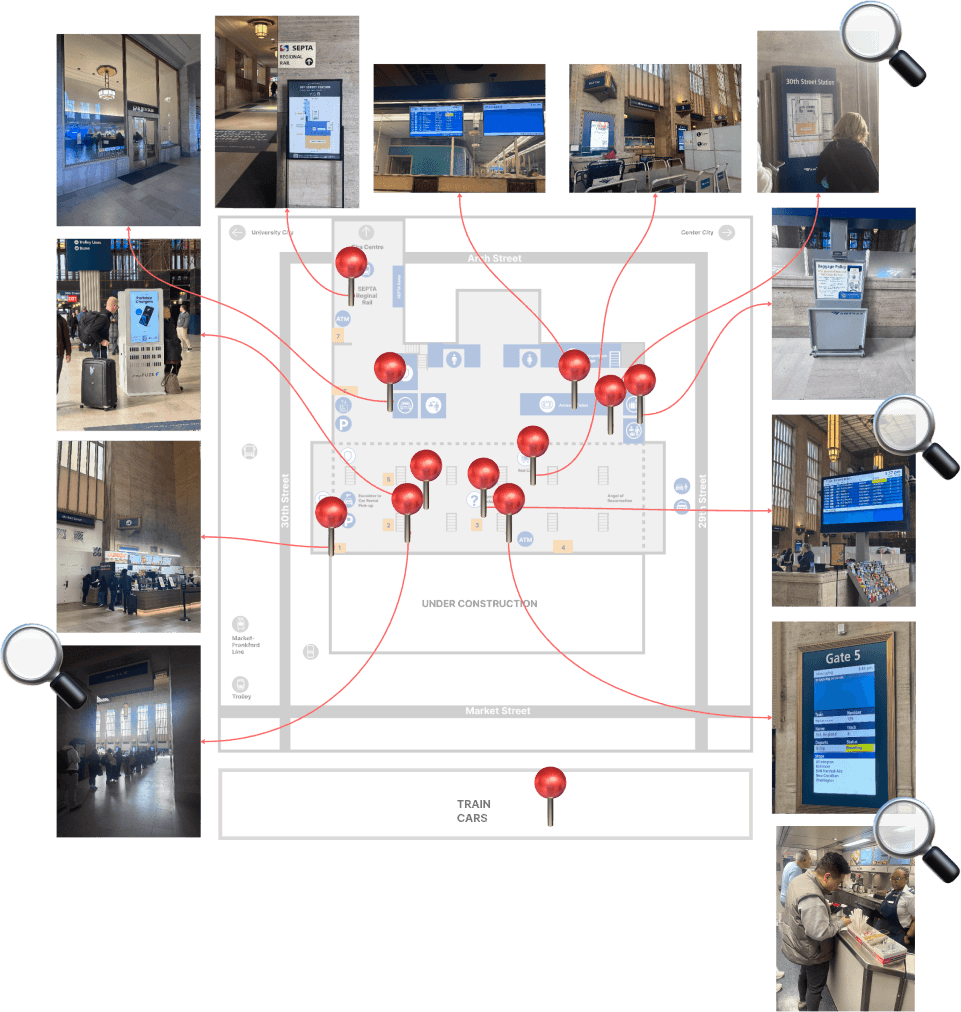
Station infrastructure mapped
Station infrastructure mapped
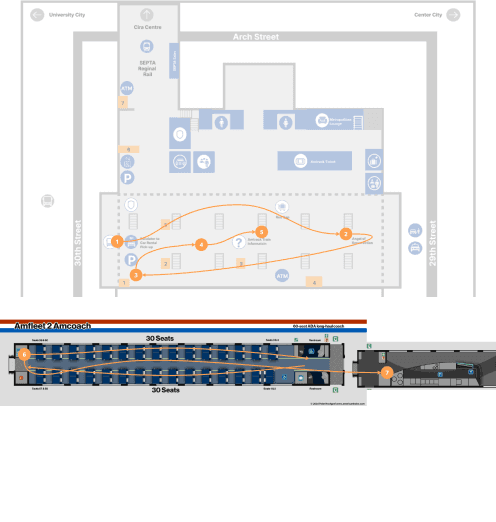
A first-time traveler's actual path through the station
Travelers
Travelers
Repeatedly checking tickets, uncertainty never fully resolved
Visible signs of confusion: furrowed brows, hesitant movement
Could only get answers by finding a staff member to confirm
Repeatedly checking tickets, uncertainty never fully resolved
Visible signs of confusion: furrowed brows, hesitant movement
Could only get answers by finding a staff member to confirm
Staffs
Staffs
"The most repeated questions are about when and where to board"
— information desk staff
"We identify first-time travelers by those who appear confused or unsure as they enter"
— station staff
"The most repeated questions are about when and where to board"
— information desk staff
"We identify first-time travelers by those who appear confused or unsure as they enter"
— station staff
We were tasked with understanding why first-time riders don't return, and designing solutions to change that.
We were tasked with understanding why first-time riders don't return, and designing solutions to change that.
"Good ideas, but it won't really solve the problem"
"Good ideas, but it won't really solve the problem"
We brought our first concept to a co-workshop with Amtrak employees, their response was honest: the ideas had merit, and some were already being explored internally. But something more fundamental was missing, and everyone in the room could feel it.
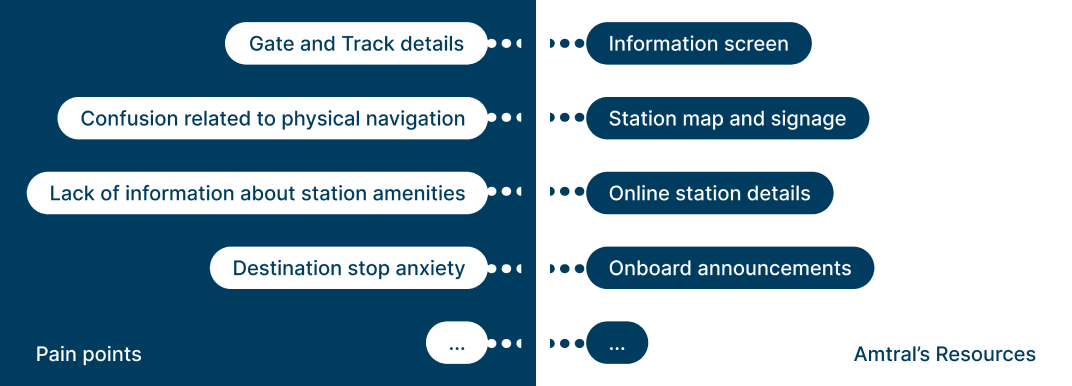
That response sent us back to the field. This time, instead of mapping pain points, we mapped Amtrak's existing resources against every user need we'd identified. What we found reframed everything.
We brought our first concept to a co-workshop with Amtrak employees, their response was honest: the ideas had merit, and some were already being explored internally. But something more fundamental was missing, and everyone in the room could feel it.
That response sent us back to the field. This time, instead of mapping pain points, we mapped Amtrak's existing resources against every user need we'd identified. What we found reframed everything.
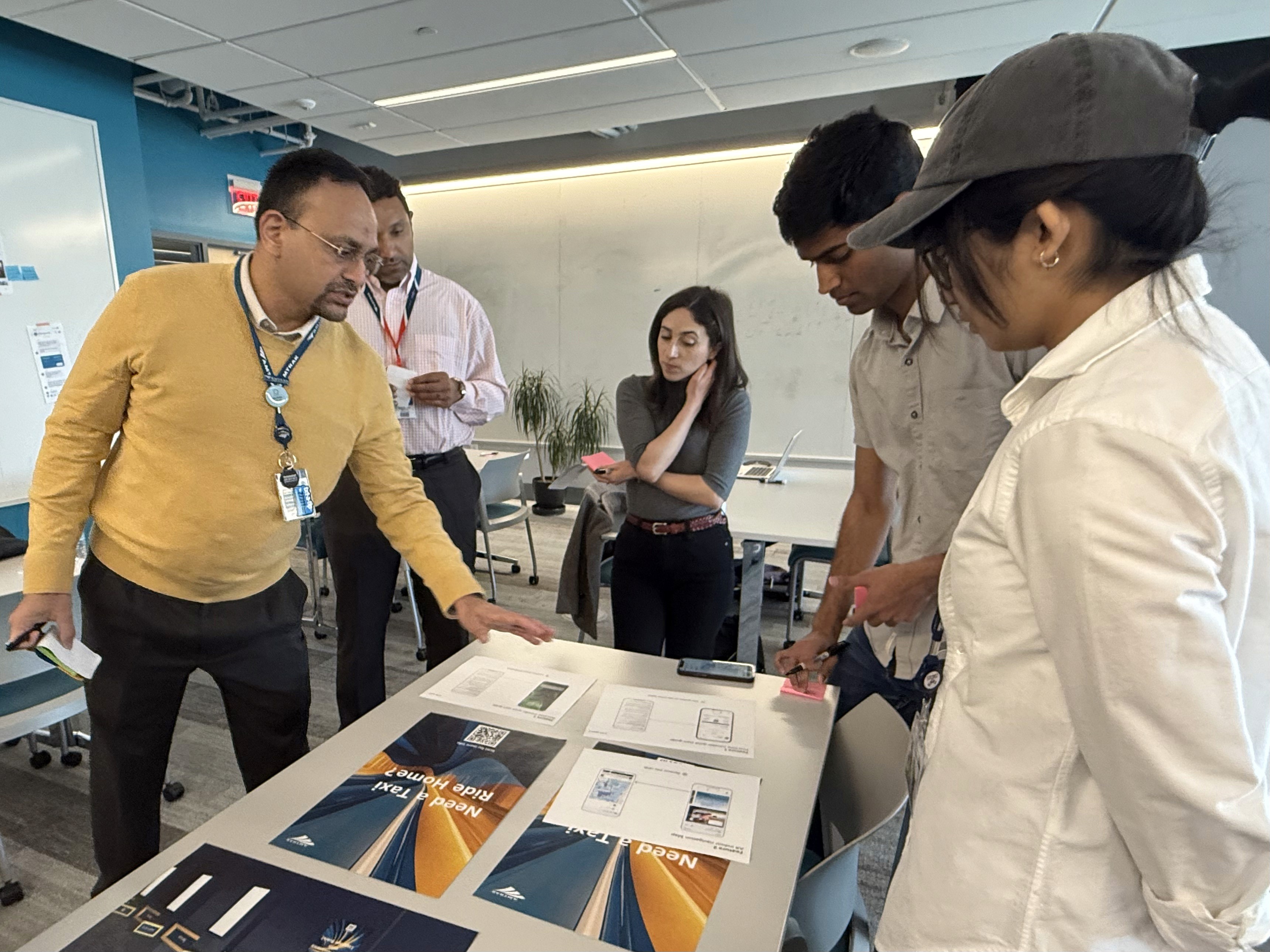
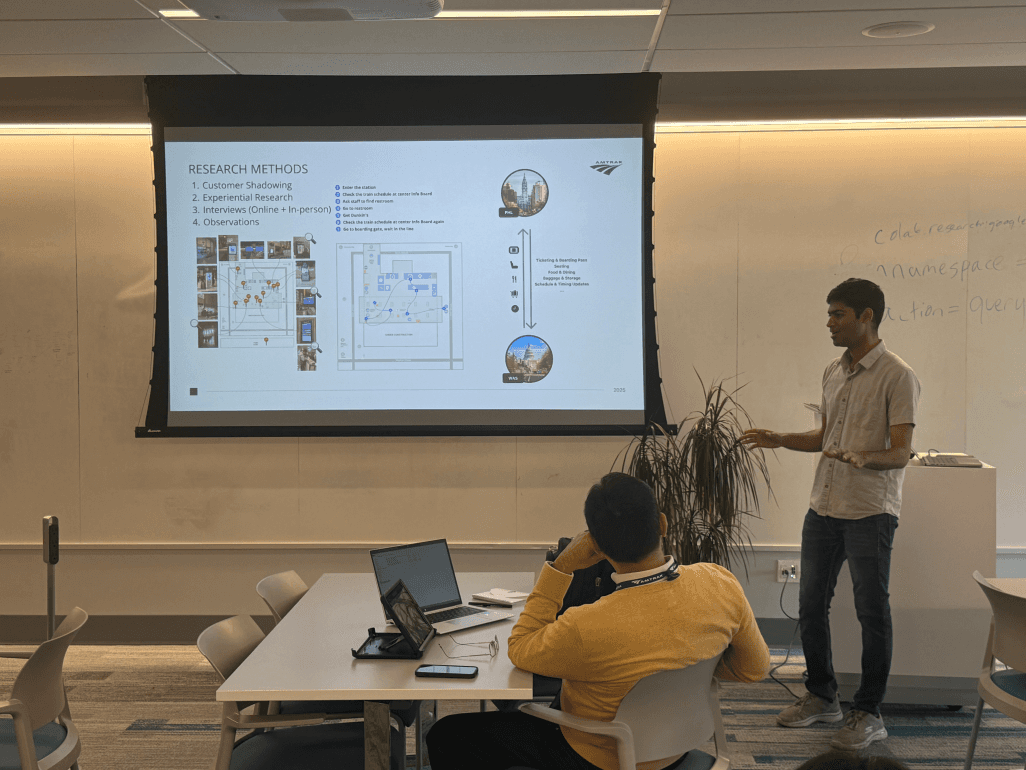
Co-workshop with Amtrak employees
The real problem lies in missing delivery
The real problem lies in missing delivery
Amtrak already has answers to nearly every question a lost traveler might ask. The infrastructure exists. But none of it reaches users until after confusion has set in. Which led us to this ignored stage: has the service been proactively delivered to the users?
That realization also changed who we were designing for. "First-time traveler" is just a label, we shouldn’t be trapped by it. What’s truly important is the shared behavior pattern beneath it. Anyone who doesn't know what to do next counts.
I shifted product direction from "users find services" to "services reach users".
Amtrak already has answers to nearly every question a lost traveler might ask. The infrastructure exists. But none of it reaches users until after confusion has set in. Which led us to this ignored stage: has the service been proactively delivered to the users?
That realization also changed who we were designing for. "First-time traveler" is just a label, we shouldn’t be trapped by it. What’s truly important is the shared behavior pattern beneath it. Anyone who doesn't know what to do next counts.
I shifted product direction from "users find services" to "services reach users".
User
Before
Before
Reframe
Reframe
User
User
People taking Amtrak for the first time
People taking Amtrak for the first time
Anyone who shares a similar sense of unfamiliarity with the Amtrak experience
Anyone who shares a similar sense of unfamiliarity with the Amtrak experience
Direction
Direction
Fix each pain point individually
Fix each pain point individually
Close the information gap proactively, at every stage of the journey
Close the information gap proactively, at every stage of the journey
A Proactive, Hybrid System
Built Around The Journey
A Proactive, Hybrid System
Built Around The Journey
DESIGN
Instead of fixing individual pain points, we designed a system that anticipates what unfamiliar travelers need, and delivers it before they have to ask.
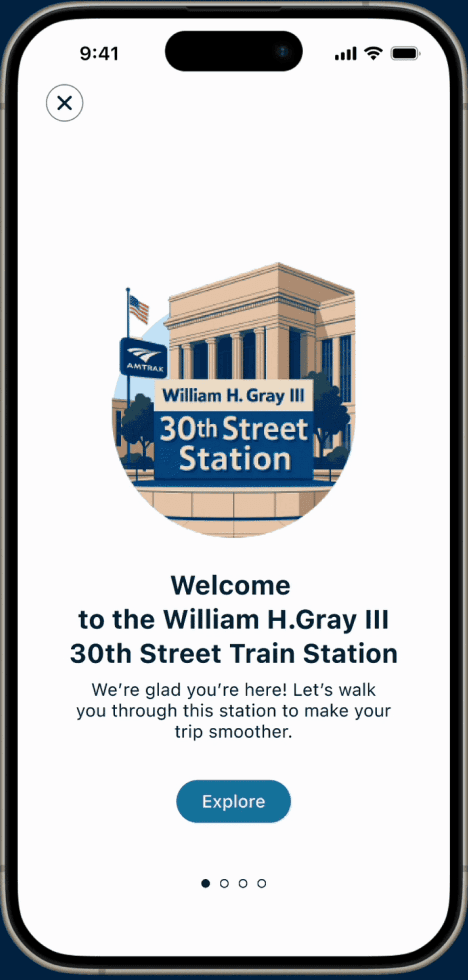
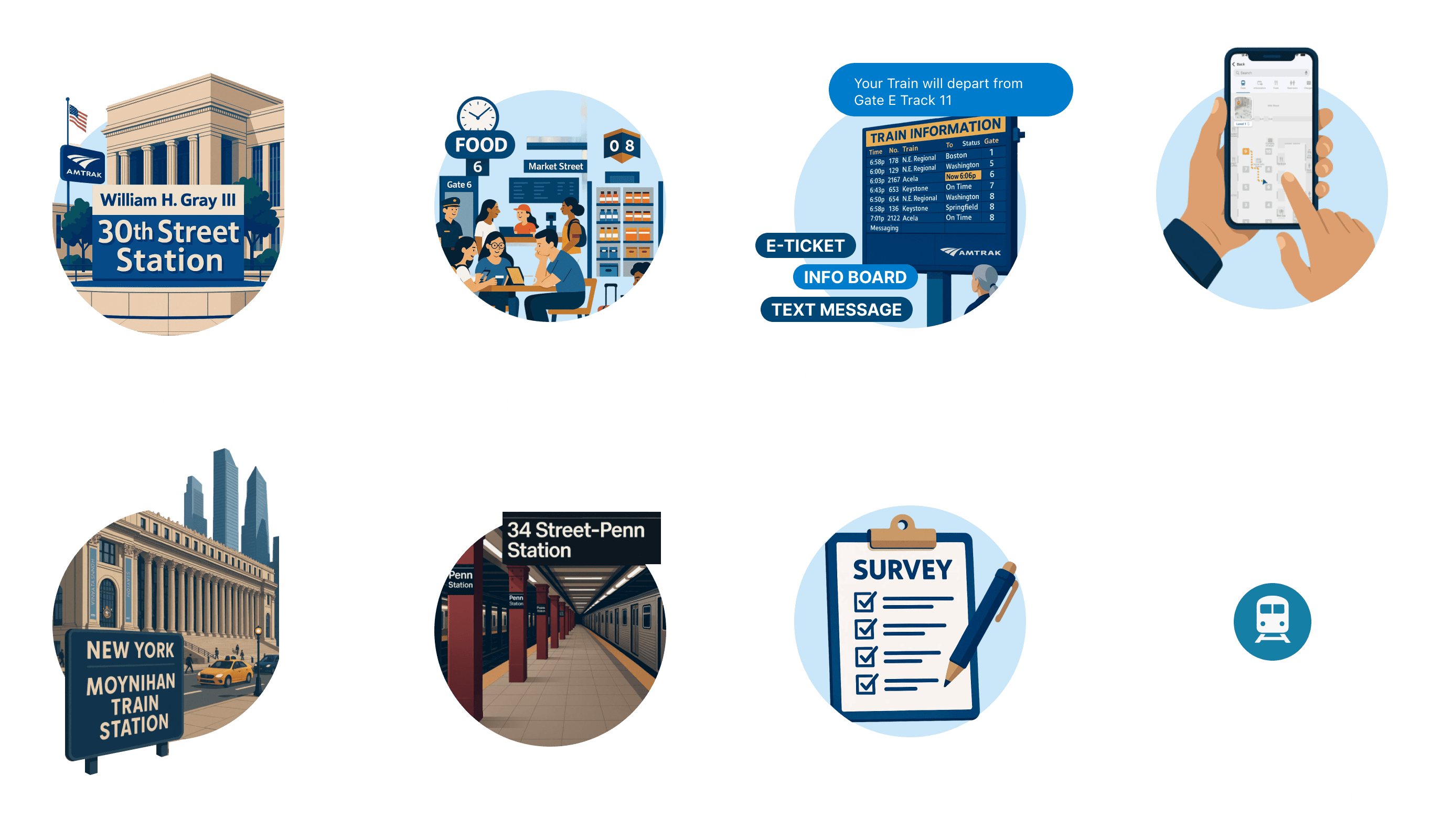
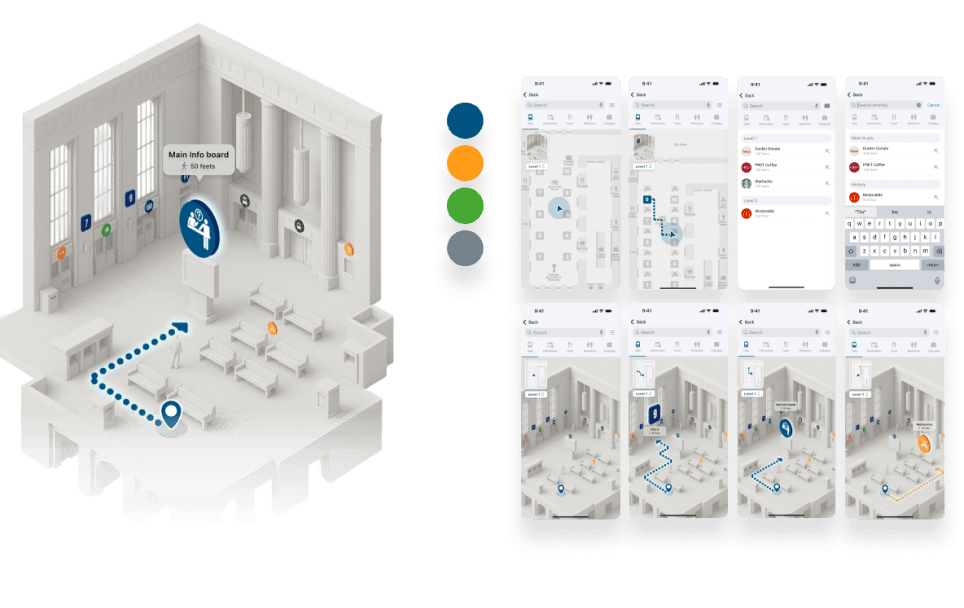
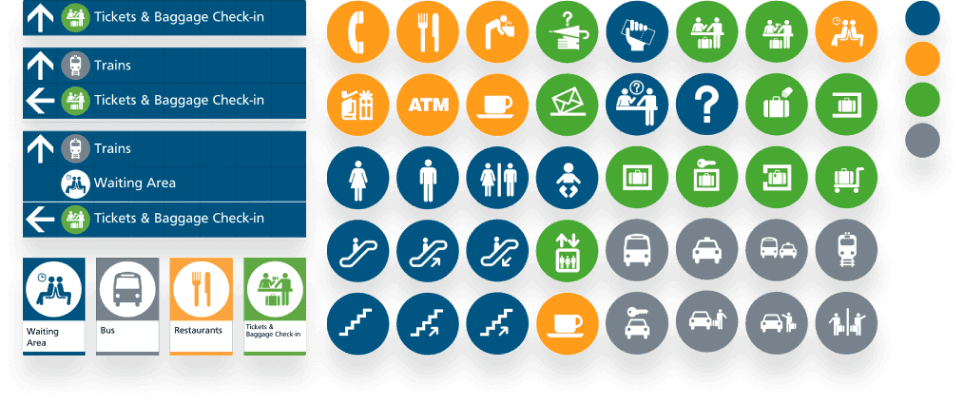
Proactive Journey Guidance
Addressing rider uncertainty through a guiding system
The reframe pointed to a clear direction: close the information gap proactively, across every stage of the journey.
We designed a digital-physical hybrid system with two core interventions: stage-based guidance and indoor navigation, supported by a unified physical signage redesign.
Layer1: Proactive Journey Guidance (Temporal)
Contextual notifications delivered at each journey stage, so travelers always know what to do next without having to ask.
Proactive Journey Guidance
Layer1: Proactive Journey Guidance (Temporal)
Contextual notifications delivered at each journey stage, so travelers always know what to do next without having to ask.
Addressing rider uncertainty through a guiding system
The reframe pointed to a clear direction: close the information gap proactively, across every stage of the journey.
We designed a digital-physical hybrid system with two core interventions: stage-based guidance and indoor navigation, supported by a unified physical signage redesign.
Taking it further
Taking it further
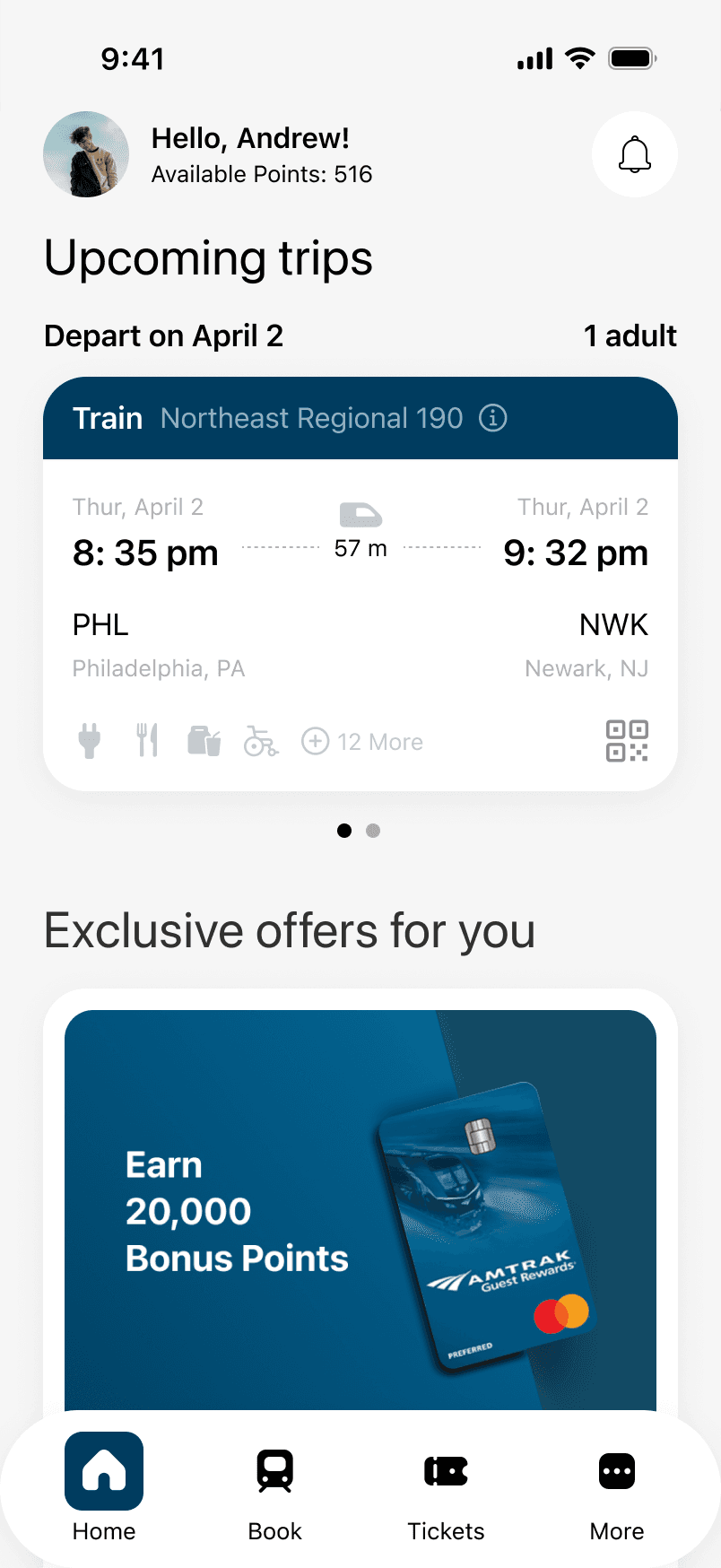
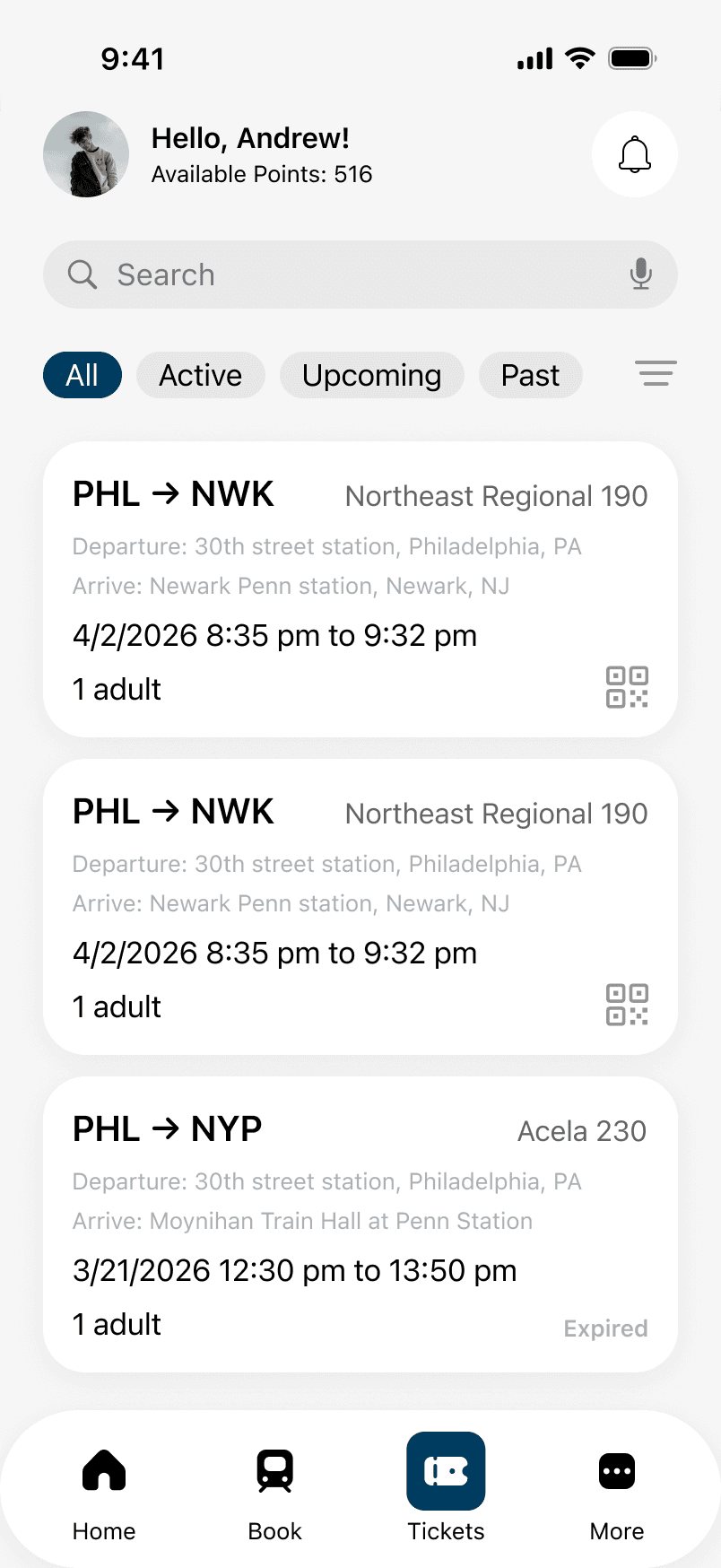
I redesigned the full UX flow independently (from booking to trip end).
I redesigned the full UX flow independently (from booking to trip end).

After booking
All your trips, tracked in one place (e.g. departure times, train info and ticket status), are visible the moment you open the app.
At the station
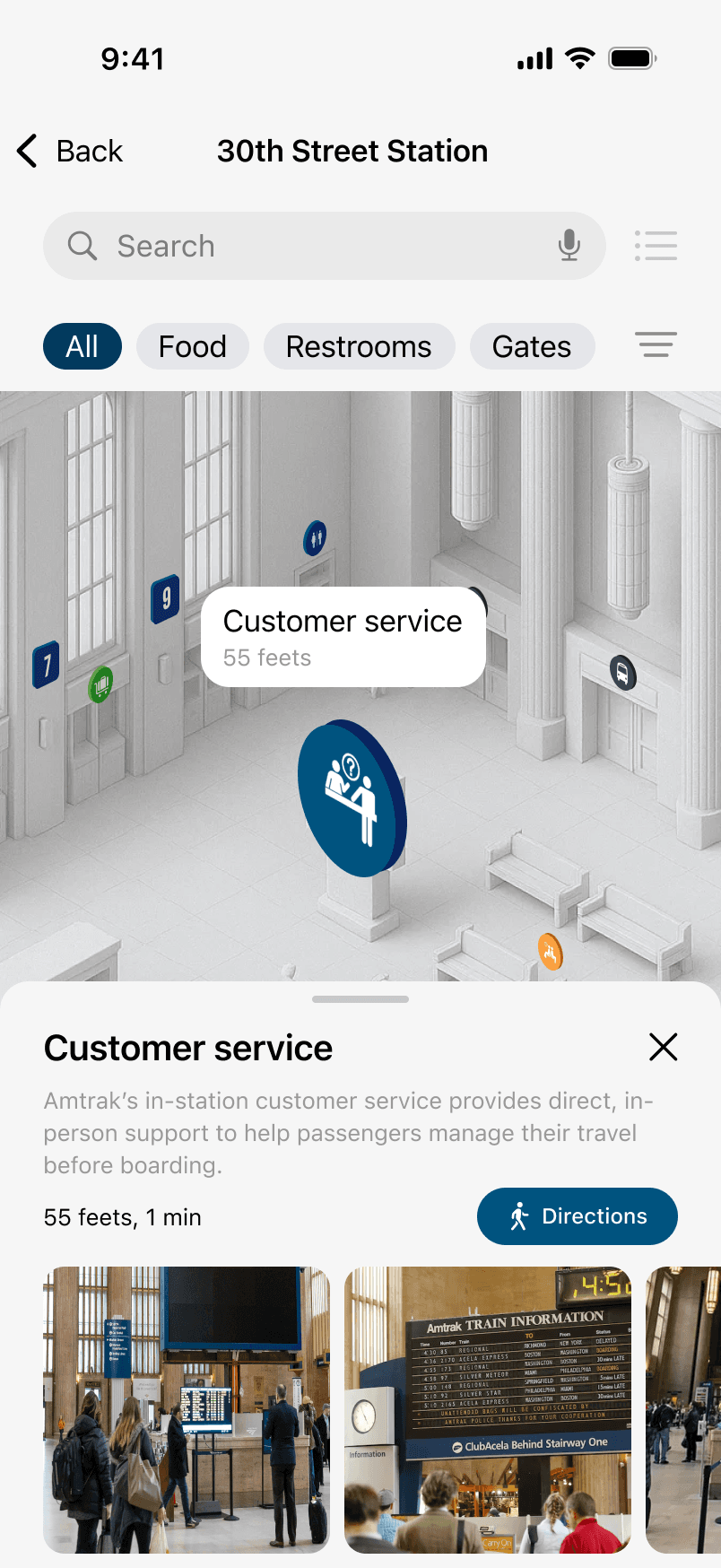
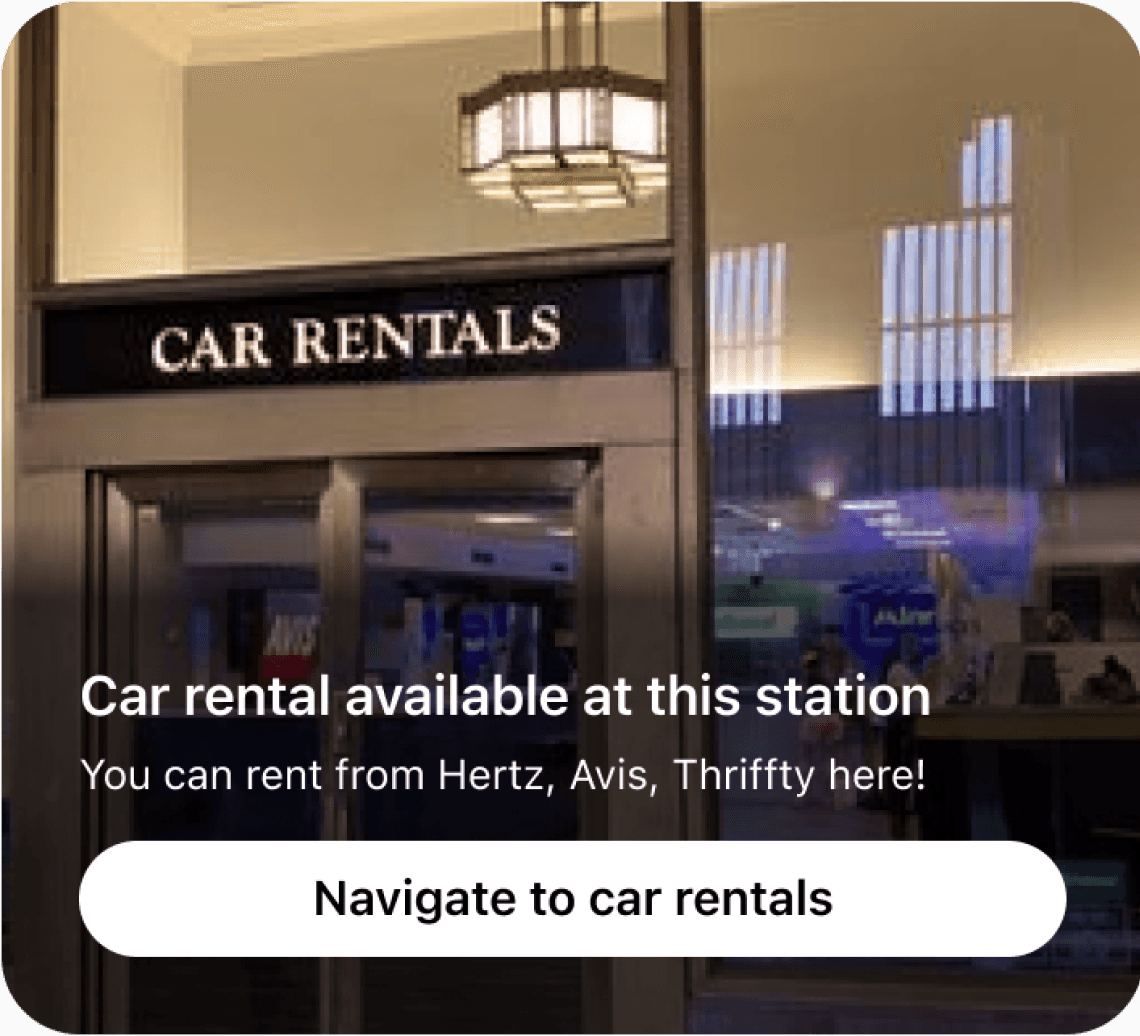
Stage-based prompts surface the right information at the right moment (e.g. station guide, food options, gate reminder). When you need more, the indoor map takes you there, step by step.
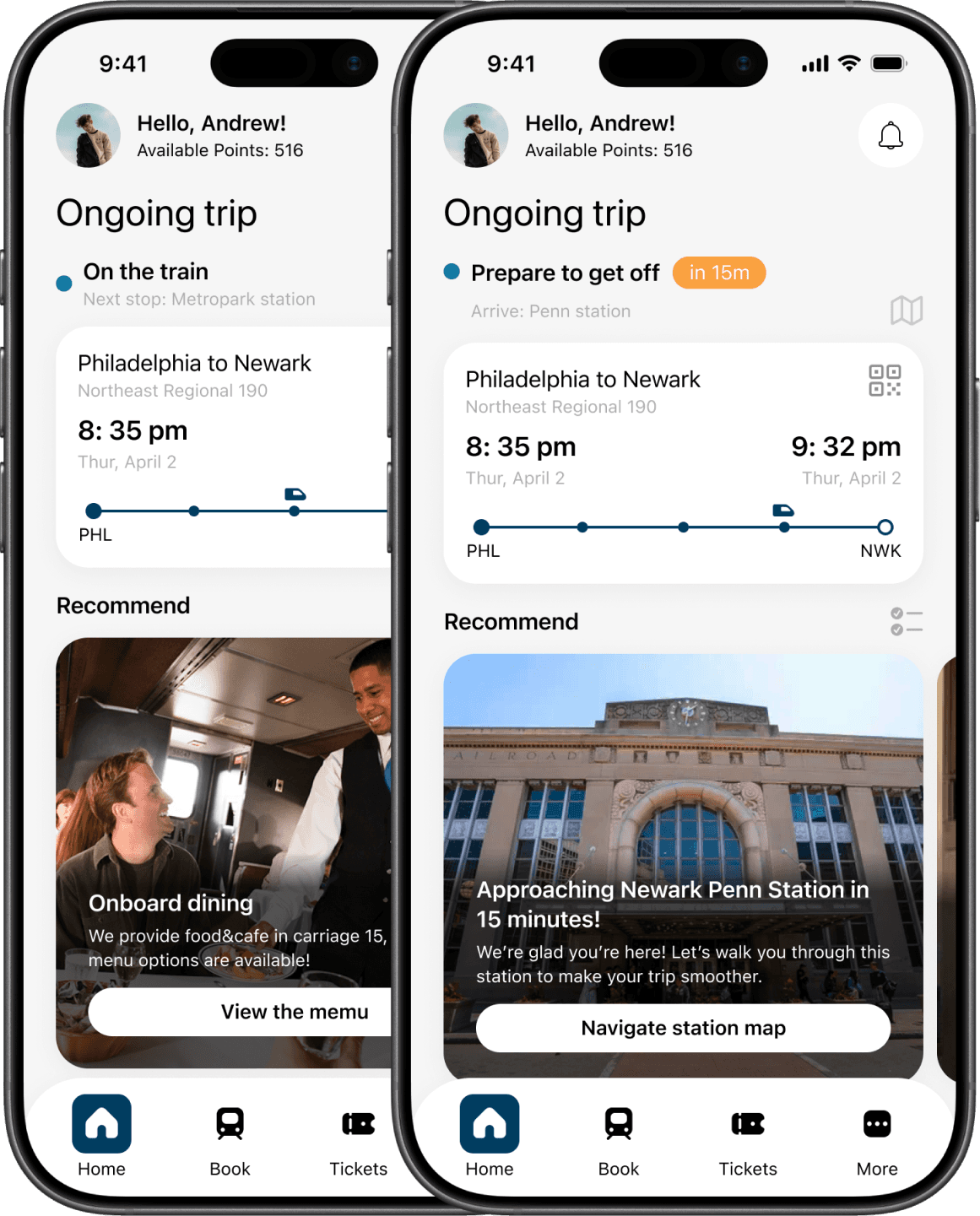
Approaching destination &
Trip end
Approaching destination &
Trip end
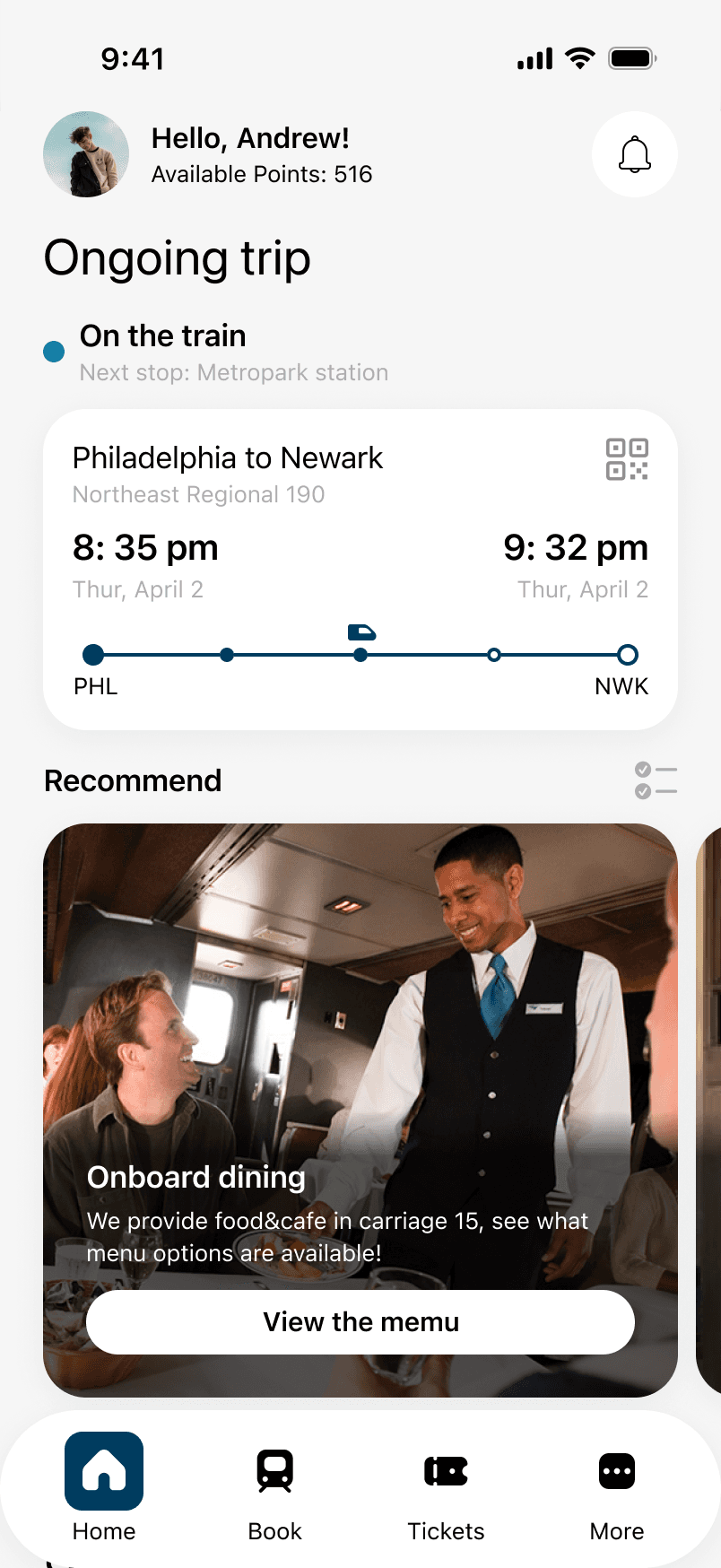
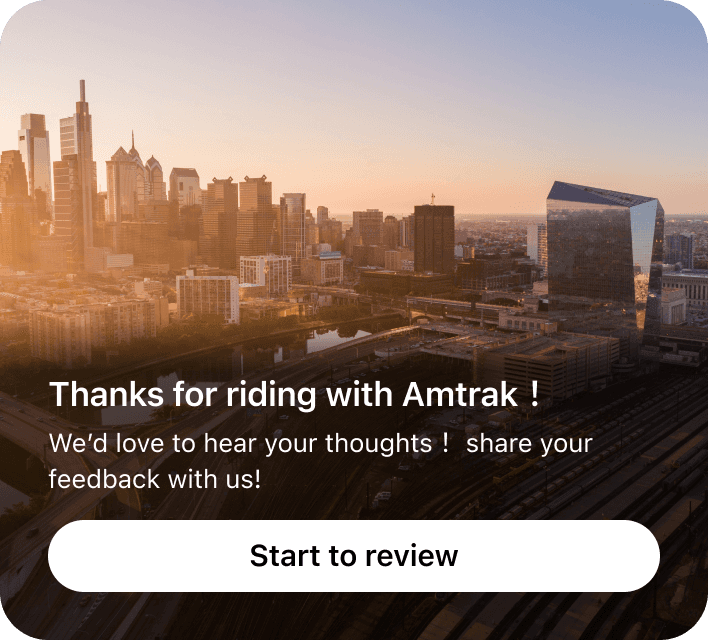
Live stop progress keeps you oriented onboard. As you approach your destination, a proactive alert walks you through the station ahead. Once you arrive, local services are surfaced, and the trip closes with a feedback prompt.
Validated With
12 Users
Validated With
12 Users
USABILITY TEST
Think-aloud usability test on Figma prototype (2 tasks, 12 participants). Response Google Sheet
Most participants were experienced Amtrak riders. Further testing with first-time riders is recommended to fully validate the core use case.
Task results
Task results
User
Task 1: Find reservation number
Task 1:
Find reservation number
Task 2: Find nearest restaurant
Task 2:
Find nearest restaurant
Completion
Completion
12/12
12/12
Under 15 sec
Under 15 sec
8/12
9/12
No hesitation
No hesitation
10/12
9/12
Satisfaction ratings (avg out of 5)
Satisfaction ratings (avg out of 5)
Overall flow clear and easy to follow
Overall flow clear and easy to follow
4.7
Could quickly find needed information
Could quickly find needed information
4.7
App made me feel confident
App made me feel confident
4.5
Would trust this app as a first-time rider
Would trust this app as a first-time rider
4.2
More satisfied than the current Amtrak app
More satisfied than the current Amtrak app
4.2

Significant improvement in user satisfaction validated by testing
Significant improvement in user satisfaction validated by testing
Across 12 participants, both tasks achieved 100% completion rate (most within 15 seconds). Satisfaction scores averaged above 4.5 across clarity, confidence, and ease of navigation. The core interaction model held up without guidance.
Across 12 participants, both tasks achieved 100% completion rate (most within 15 seconds). Satisfaction scores averaged above 4.5 across clarity, confidence, and ease of navigation. The core interaction model held up without guidance.
Three potential future iteration from open feedback:
The QR code entry point needs to be more prominent
The 3D map has a learning curve for unfamiliar users
The ticketing UI is slightly busy
Three potential future iteration from open feedback:
The QR code entry point needs to be more prominent
The 3D map has a learning curve for unfamiliar users
The ticketing UI is slightly busy
Questioning The Frame Matters
As Much As Solving The Problem
Questioning The Frame Matters
As Much As Solving The Problem
REFLECTION
First principles over given frameworks
First principles over given frameworks
The client came with a problem definition already in hand. It would have been easy to work within it. But the research kept pointing elsewhere, and following that signal meant stepping outside the given frame entirely.
The client came with a problem definition already in hand. It would have been easy to work within it. But the research kept pointing elsewhere, and following that signal meant stepping outside the given frame entirely.
User voices carried more weight than any argument we could have made
User voices carried more weight than any argument we could have made
Our Amtrak contact initially pushed back, they wanted us to stay focused on the "first-time traveler" label. We didn't argue. We brought back the user voices, laid out the logic, and let the pattern speak for itself. By the end, they arrived at the same conclusion we had. That's a different outcome than winning an argument.
Our Amtrak contact initially pushed back, they wanted us to stay focused on the "first-time traveler" label. We didn't argue. We brought back the user voices, laid out the logic, and let the pattern speak for itself. By the end, they arrived at the same conclusion we had. That's a different outcome than winning an argument.
A pivot lands better when the team sees the necessity, not just the decision
A pivot lands better when the team sees the necessity, not just the decision
When we decided to abandon our first concept, the team felt it as a loss. My job as lead wasn't to push forward — it was to reframe what had happened. The first round of research wasn't wasted; it showed us exactly which direction wouldn't work. That distinction mattered. A team that understands why it's pivoting moves differently than one that's just told to.
When we decided to abandon our first concept, the team felt it as a loss. My job as lead wasn't to push forward — it was to reframe what had happened. The first round of research wasn't wasted; it showed us exactly which direction wouldn't work. That distinction mattered. A team that understands why it's pivoting moves differently than one that's just told to.
Next Project
2/4
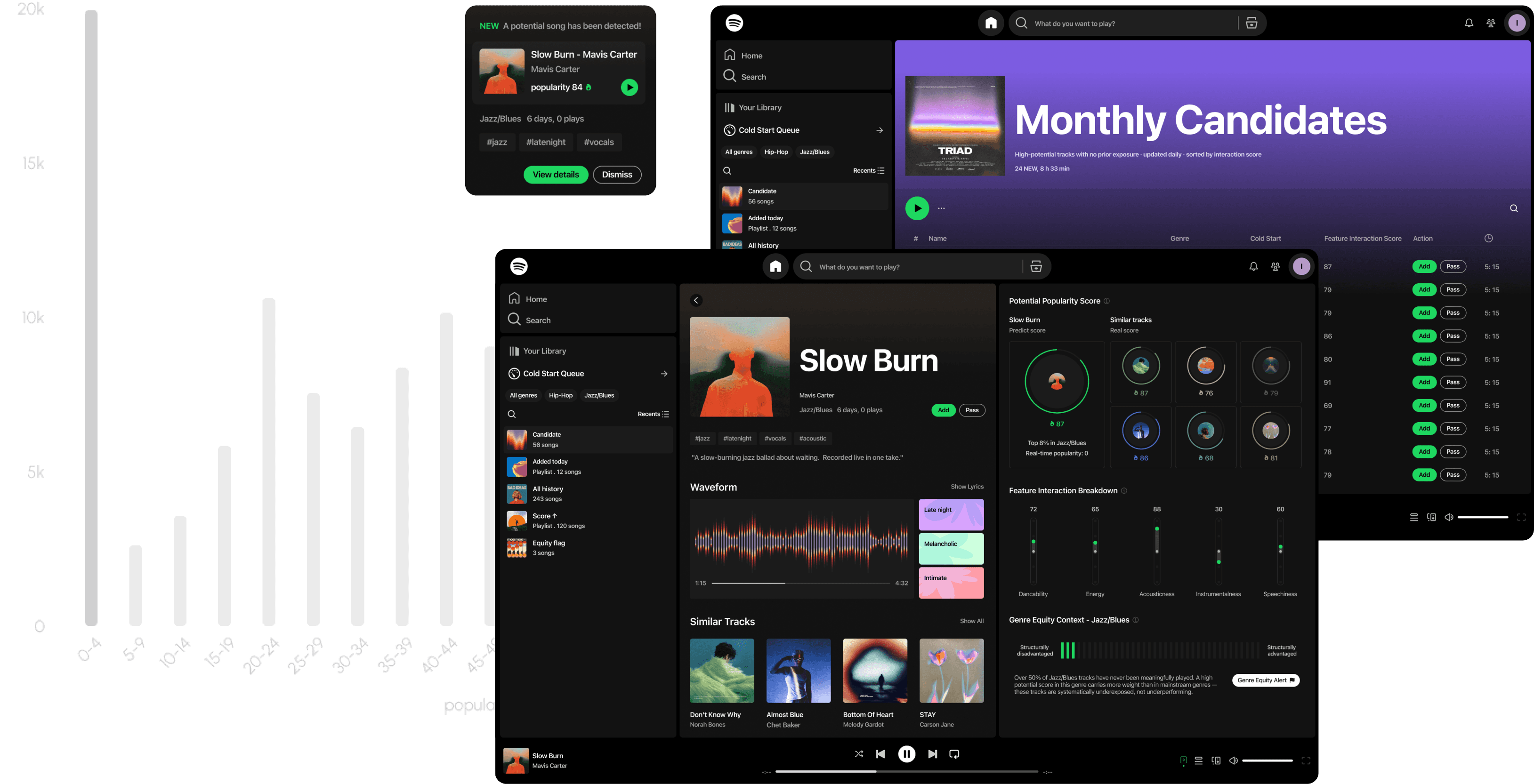
Music Discovery & the Cold Start Problem
Next Project
2/4
Music Discovery & the Cold Start Problem